
Markdown as a Token-Efficiency Layer for Enterprise GenAI
Generative AI systems can accept familiar business formats such as Microsoft Word, PowerPoint, and PDF. That does not mean those formats are equally efficient inputs.
A .docx, .pptx, or PDF file is designed primarily to preserve appearance, application behavior, and page layout. A Markdown file is designed to represent document structure as readable text. When the purpose of a GenAI task is to summarize, analyze, compare, revise, classify, or reuse document content, a clean, preformatted .md version can reduce the amount of irrelevant material that must be extracted, interpreted, or repeatedly submitted to the model.
The potential benefit is not merely lower file size. It is a reduction in effective token consumption, preprocessing work, ambiguity, and failed or corrective interactions.
The Important Distinction: File Size Is Not Token Count
GPT models process tokens rather than Microsoft Office files, PDFs, pages, or bytes. For English-language material, OpenAI provides the general approximation that one token represents about three-quarters of a word, meaning that 1,500 words require approximately 2,000 tokens. Actual tokenization varies by language, punctuation, formatting, and model. (help.openai.com)
A 10 MB Word document does not automatically consume more model tokens than a 500 KB Markdown file containing the same words. The binary ZIP, XML, font, image, and application data inside the Word file are not ordinarily passed directly to the language model as textual tokens.
Instead, the system must first extract a usable representation from the source file. The token implications arise from what that extraction produces:
- Repeated headers and footers
- Page numbers
- Slide labels and placeholders
- Speaker notes
- Text-box ordering errors
- Table reconstruction
- Image descriptions
- OCR output
- XML-derived structural artifacts
- Duplicated text
- Unnecessary metadata
- Instructions needed to resolve ambiguous layout
OpenAI supports common formats including DOCX, PPTX, PDF, TXT, XLSX, and CSV. Text and document files uploaded to ChatGPT are generally subject to a two-million-token limit per file. (help.openai.com) The existence of broad format support, however, does not establish that all formats produce identical extracted representations or consume identical processing resources.
Why Markdown Is More Efficient
A well-prepared Markdown file presents the model with material that is already close to its preferred working form:
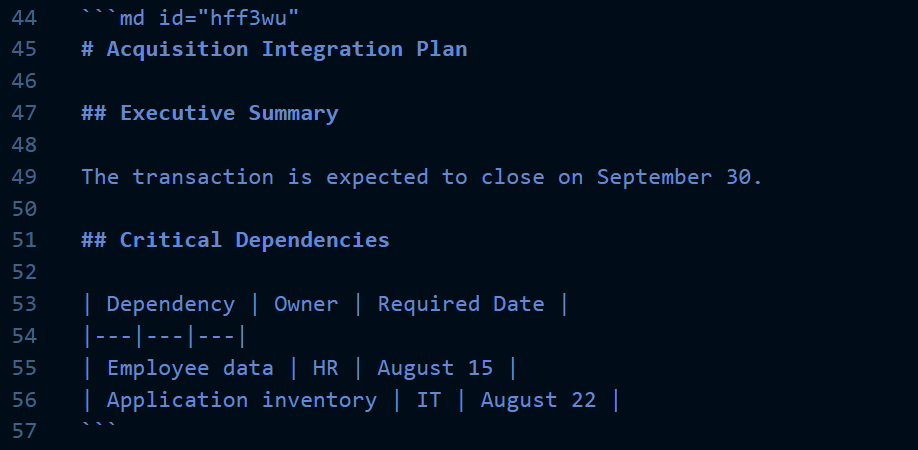
The hierarchy is explicit. Headings, paragraphs, lists, tables, emphasis, links, and code blocks can be identified without reconstructing page geometry or application-specific formatting.
By contrast, a Word, PowerPoint, or PDF version may require the ingestion system to determine:
1. Which visual objects contain substantive content.
2. In what order the objects should be read.
3. Whether text is a heading, caption, footer, note, label, or body paragraph.
4. Whether repeated material should be retained.
5. How tables and columns should be linearized.
6. Whether graphical content must be described or interpreted.
7. Whether OCR is necessary.
Markdown therefore operates as a **normalization layer** between enterprise content systems and GenAI tools.
## What “Conversion Tokens” Actually Mean
There are three distinct conversion models.
### 1. Deterministic conversion outside the model
A conventional program such as Pandoc, MarkItDown, Apache Tika, LibreOffice, or a custom parser converts the source file to Markdown before submission.
**Direct LLM token consumption for conversion: zero.**
The conversion uses conventional computing resources rather than language-model inference. Tokens are consumed only when the resulting Markdown is submitted to the model.
This is ordinarily the most economical approach for high-volume enterprise use.
### 2. Platform-managed extraction
The user uploads a DOCX, PPTX, or PDF directly to a GenAI platform. The platform extracts text and structure before or during model processing.
The exact internal extraction cost and the extent to which it is included in reported token usage are generally not publicly documented. It would therefore be inaccurate to claim that uploading a DOCX automatically incurs a fixed number of “conversion tokens.”
The relevant measurable quantity is the number of tokens in the **extracted representation ultimately used by the model**, together with any image or multimodal processing charges.
### 3. Model-directed conversion
The file is extracted, and the language model is then asked to clean, reorganize, or convert the extracted content into Markdown.
This method consumes:
– Tokens for the extracted source representation
– Tokens for the conversion instructions
– Output tokens for the Markdown version
– Potential additional tokens for checking and correcting the conversion
This is the least token-efficient option when conversion can be performed deterministically.
## Estimated Token Consumption by Format
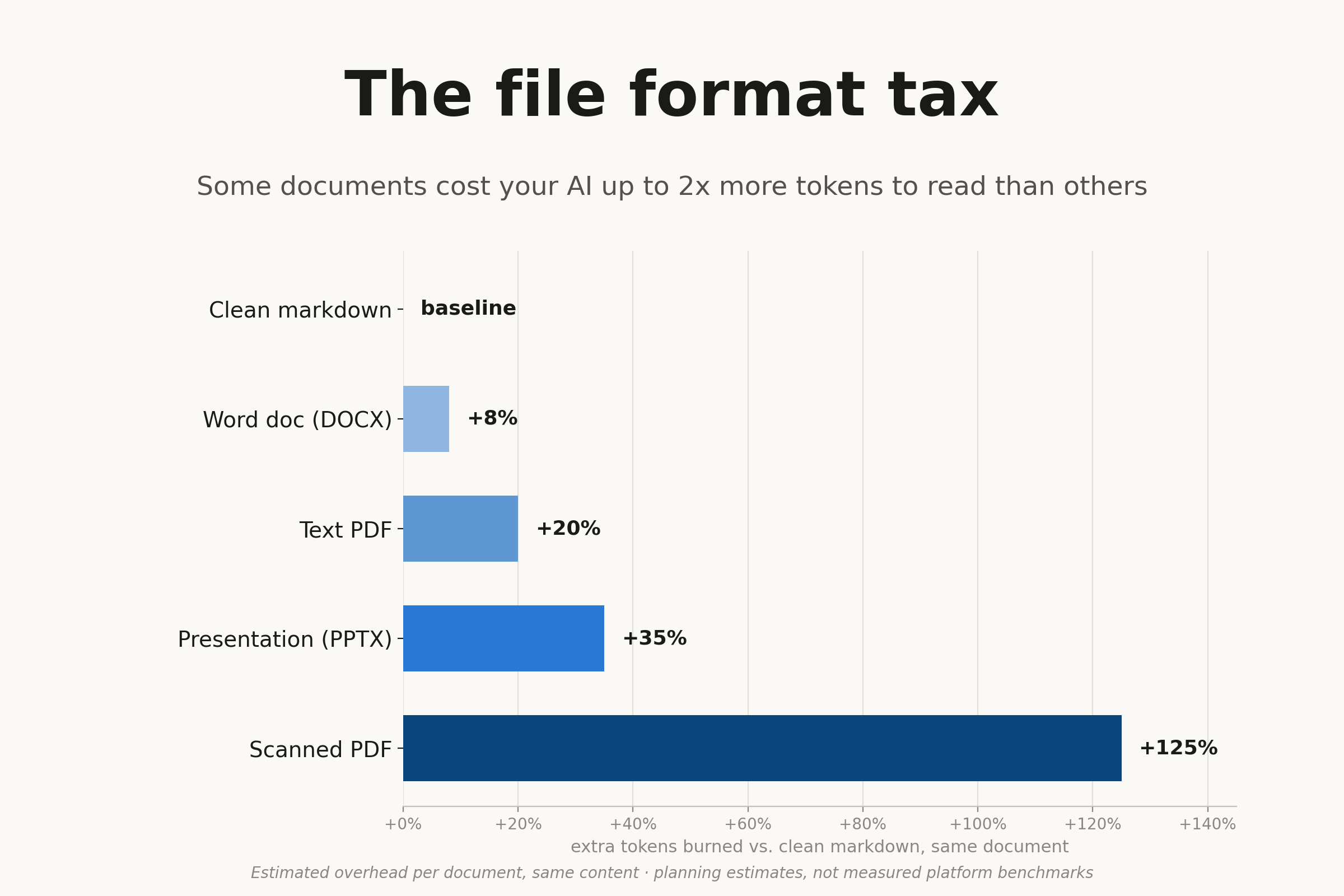
OpenAI does not publish standard conversion multipliers for DOCX, PPTX, or PDF files. The following ranges are therefore **planning estimates**, not measured OpenAI rates.
The estimates assume an English-language business document containing approximately 7,500 substantive words, equivalent to roughly 10,000 useful-content tokens.
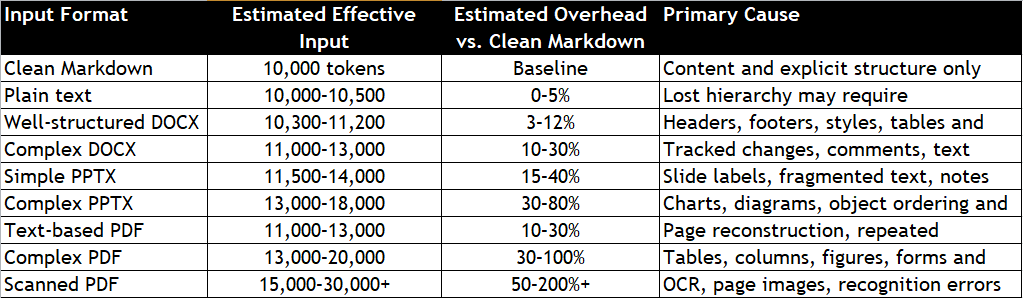
These ranges should be treated as workload-design assumptions. Actual results depend on the model, platform, extraction pipeline, document design, language, images, and the scope of the user’s request.
## Estimating Model-Based Conversion
Suppose a 10,000-token extracted Word document is submitted with the instruction:
> Convert this document to clean Markdown while preserving all substantive content.
A representative conversion could consume:
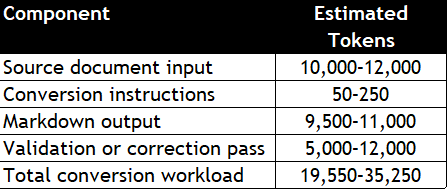
The resulting Markdown file may then be submitted again for the actual analysis, consuming another approximately 10,000 input tokens.
A model-directed conversion workflow can therefore use approximately **30,000–45,000 tokens before or during the first substantive task** involving a 10,000-token document.
A deterministic conversion performed before upload may require only the final 10,000-token Markdown input. The potential reduction is approximately **20,000–35,000 tokens for that first use**.
The savings become more pronounced when the same normalized file is reused across multiple prompts, models, workflows, or employees.
## The Greater Savings: Repeated Use
The principal enterprise value of Markdown does not come from converting a file once. It comes from avoiding repeated conversion and interpretation.
Consider a source document used for five GenAI tasks:
1. Executive summary
2. Risk extraction
3. Contract-obligation table
4. Comparison with a second document
5. Creation of a presentation outline
When the original source file is uploaded separately for each task, its extraction overhead may recur five times. A normalized Markdown representation can be stored once and passed consistently to each workflow.
Using a conservative 15% source-format overhead on a 10,000-token document:

The corrective-pass range reflects a second source of savings: cleaner structure can reduce mistakes caused by reading order, table extraction, hidden content, or ambiguous formatting.
## Enterprise Scenario: 500 Daily GenAI Users
Consider a company with 500 employees who use GenAI daily to analyze, revise, compare, and create business documents.
### Scenario assumptions
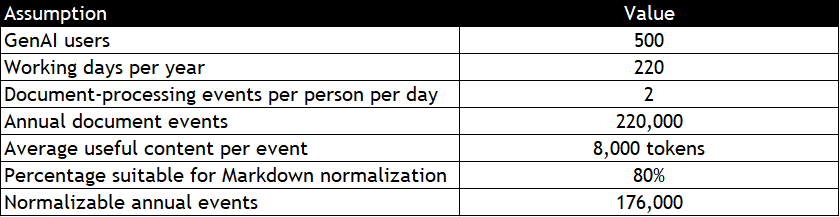
A document-processing event means one source document being supplied to a GenAI workflow. It does not necessarily mean 220,000 unique files; the same file may appear in several events.
### Assumed source-format mix
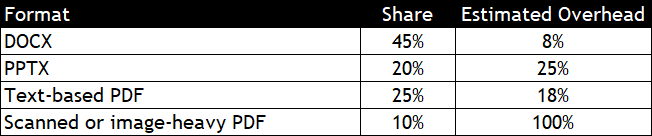
The weighted estimated overhead is:
\[
(45\% \times 8\%) +
(20\% \times 25\%) +
(25\% \times 18\%) +
(10\% \times 100\%)
= 23.1\%
\]
At 8,000 useful-content tokens per event, the estimated avoidable format-related input is:
\[
8,000 \times 23.1\% = 1,848\text{ tokens per event}
\]
Applied to the 176,000 annual events suitable for normalization:
\[
176,000 \times 1,848
= 325,248,000\text{ tokens}
\]
The company could therefore avoid approximately **325 million input tokens annually** under the base assumptions.
## Impact of Corrective and Repeated Processing
Source-format problems can also lead to:
– Requests to “try again”
– Missing-table corrections
– Requests to disregard headers or footers
– Re-uploading a different file version
– Reformatting extracted text
– Manual copying and pasting
– Regeneration of incomplete outputs
Assume that 15% of source-file events require one additional processing pass and that Markdown normalization reduces that rate to 5%.
The difference is 10% of 176,000 events, or 17,600 avoided repeat passes.
At approximately 9,848 tokens per source-format event, including useful content and estimated overhead:
\[
17,600 \times 9,848
= 173,324,800\text{ tokens}
\]
Combined with the direct format-overhead reduction:
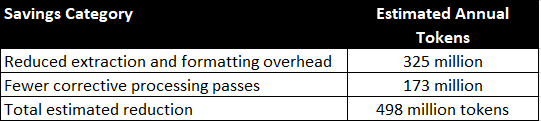
Rounded for planning purposes, the enterprise could reasonably model **approximately 500 million fewer input tokens per year**.
## Sensitivity Range
Because document complexity and workflow behavior vary widely, a range is more defensible than a single figure.

The high-complexity case is most applicable where employees routinely process scanned PDFs, presentation decks, reports with complex tables, forms, or documents assembled from multiple applications.
## Document Creation Also Benefits
Markdown can reduce token use on the output side when the model is asked to create content.
A request to generate a fully formatted Word document or PowerPoint presentation may require the model or an associated tool to reason about:
– Page layout
– Fonts
– margins
– slide placement
– text-box sizing
– table dimensions
– headers and footers
– pagination
– file-generation code
– repeated rendering and correction
A Markdown-first workflow separates **content generation** from **document rendering**:
1. GPT produces structured Markdown.
2. A deterministic template engine converts Markdown to DOCX, PPTX, HTML, or PDF.
3. Corporate styles are applied outside the model.
4. The rendered file is checked mechanically where possible.
The token savings depend on the implementation, but the operational advantage is clear: the model concentrates on content and structure, while repeatable software handles presentation.
## When Markdown Does Not Save Tokens
Markdown is not always the appropriate canonical input.
The original source file should remain available when the task depends on:
– Precise page layout
– Visual design
– Slide composition
– Charts and diagrams
– Handwritten annotations
– Signatures
– Forms
– Redlines or tracked changes
– Embedded spreadsheets
– Image placement
– Legal pagination
– Document authenticity
– Exact reproduction
For these tasks, converting the source exclusively to Markdown may remove information that the model needs.
A better architecture retains both versions:
– **Authoritative source:** DOCX, PPTX, XLSX, or PDF
– **AI-ready derivative:** normalized Markdown
– **Asset directory:** extracted images, charts, and attachments
– **Manifest:** source filename, version, conversion date, hash, and relationships
The Markdown file becomes the default input for text-centered GenAI work, while the original file remains available for validation and visual analysis.
## Enterprise Implementation Model
A practical enterprise document pipeline would operate as follows:
“`text id=”tijwzt”
Source file
↓
Malware and access-control check
↓
Deterministic format parser
↓
Content normalization
↓
Markdown + metadata + extracted assets
↓
Quality-control rules
↓
Approved AI-ready repository
↓
GenAI applications
The normalization process should remove or standardize:
- Repeated headers and footers
- Page numbers
- Decorative elements
- Empty placeholders
- Hidden presentation objects
- Duplicate text
- Broken line wrapping
- Unnecessary style declarations
It should preserve:
- Heading hierarchy
- Lists
- Tables
- Footnotes
- Hyperlinks
- Captions
- Section boundaries
- Comments or tracked changes when relevant
- References to charts and images
- Source-page or source-slide identifiers where traceability matters
Measuring Actual Savings
An enterprise should not rely indefinitely on generic percentage assumptions. A controlled benchmark can establish organization-specific values.
A representative test should include at least:
- 25 DOCX files
- 25 PPTX files
- 25 text-based PDFs
- 25 scanned or complex PDFs
- A mixture of short, medium, and long documents
- Several recurring business tasks
For each file, record:
- Tokens in the extracted source representation.
- Tokens in the normalized Markdown.
- Tokens used by the prompt.
- Tokens used by the response.
- Number of corrective prompts.
- Accuracy of headings, tables, and reading order.
- Human review time.
- Conversion failures.
- Information lost during normalization.
- Total processing cost and latency.
OpenAI identifies tiktoken as the mechanism for estimating token counts programmatically before text is submitted to supported models. (help.openai.com)
The resulting measurements can replace the planning estimates in this article with actual organizational data.
Conclusion
Preformatted Markdown does not create savings simply because .md files are smaller than DOCX, PPTX, or PDF files. Binary file size and token consumption are different measures.
The savings arise because Markdown can provide GenAI systems with a cleaner, more explicit, and more reusable representation of document content. It can reduce extraction noise, structural ambiguity, multimodal processing, repeated conversion, correction prompts, and model-generated formatting work.
For a 500-person enterprise conducting two document-centered GenAI activities per employee per working day, a reasonable planning model produces estimated savings of approximately:
- 180–220 million tokens annually in a conservative case
- 450–550 million tokens annually in a base case
- 750 million to 1 billion tokens annually in a complex-document environment
These figures are scenario estimates rather than published platform benchmarks. Their primary value is to establish the scale of the opportunity and the measurements needed for validation.
The defensible enterprise position is therefore not that Markdown always uses a fixed percentage fewer tokens. It is that a Markdown-first, source-preserving document architecture can materially reduce effective GenAI consumption wherever the required information is textual and structural rather than visual.