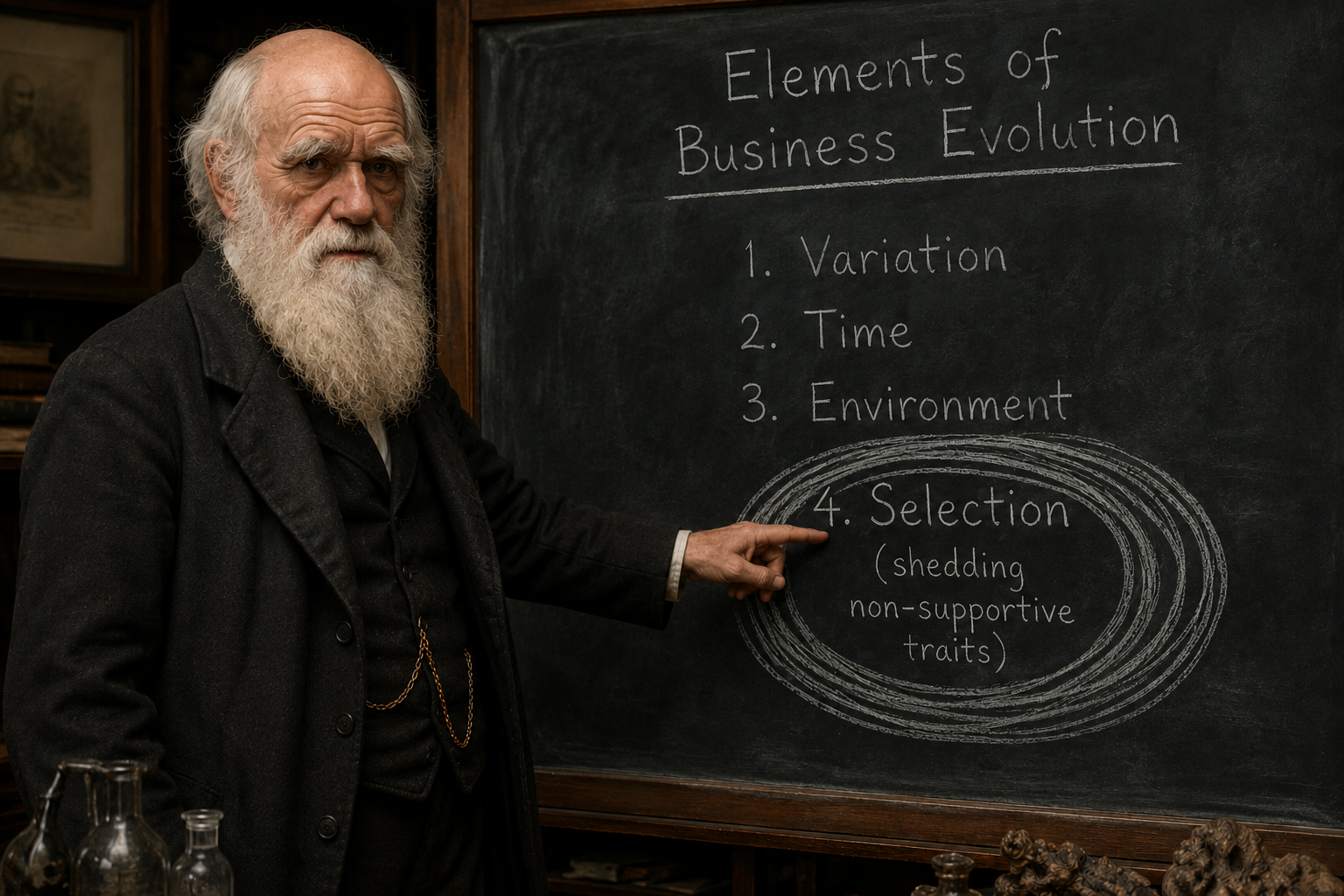
The Missing Mechanism: What Business Evolution Forgot
Nature has a brutal editor. Every trait, every behavior, every organism that doesn’t earn its keep gets cut — not eventually, not politely, but structurally, as a built-in feature of how the system works. Businesses like to describe themselves in evolutionary terms too: they “adapt,” they “compete,” they “survive.” But there’s a piece of the analogy most leaders quietly skip over. Biological evolution has a mechanism for shedding what no longer works. Most organizations don’t. They accumulate.
The Analogy That Holds
The comparison between biological evolution and business change is a familiar one, and for good reason — the mechanics line up cleanly:
- Variation in biology is random genetic mutation; in business it’s experimentation — new products, new processes, new go-to-market approaches.
- Selection pressure in biology comes from predators, climate, and scarce resources; in business it comes from competitors, customers, and market conditions.
- Retention in biology means a trait that helps an organism survive gets passed on; in business it means a behavior that works gets repeated, standardized, and scaled.
This half of the analogy is well-worn territory — “adapt or die” has been a business cliché for decades. It’s true as far as it goes. But it’s also incomplete, and the missing half is where the interesting problem lives.
Where the Analogy Breaks
Biological evolution isn’t just about what gets added. It’s equally — arguably more — about what gets removed, and removal isn’t optional or discretionary. It’s structural.
Natural selection doesn’t just favor good traits; it actively eliminates poor-fit ones by killing off the organisms that carry them. At the species level, extinction removes entire lineages that can’t keep pace with a changing environment. At the cellular level, organisms have apoptosis — programmed cell death, a mechanism cells use to deliberately self-destruct when they’re damaged, mutated, or simply no longer needed. Shedding isn’t a policy choice in biology. It’s wired into the system at every scale.
Business has no real equivalent. There’s no structural force that reliably retires a bad process, an obsolete team ritual, a legacy system nobody remembers the rationale for, or a policy written for a problem that stopped existing years ago. Things persist in organizations by default, not by merit. Survival isn’t earned the way it is in nature — it’s simply the absence of anyone deciding otherwise.
Why the gap? A few familiar culprits: sunk-cost thinking makes killing something feel like admitting past investment was wasted. Internal politics attach people’s identities and turf to the things they built, so ending them reads as a personal loss. And most fundamentally, nobody’s job is to kill things. Organizations have owners for growth, for launches, for new initiatives — they rarely have anyone whose actual mandate is retirement.
The Cost of No Shedding Mechanism
The result is a kind of organizational plaque buildup: redundant meetings that outlived their original purpose, zombie projects kept alive by momentum rather than merit, legacy tools nobody wants to migrate off of, policies designed for a market or workforce that no longer exists. None of it is fatal on its own. All of it, together, is drag.
A species that lost its capacity to shed maladaptive traits wouldn’t just be inefficient — it would be fragile, carrying the accumulated weight of every adaptation it ever tried, useful or not. Organizations that never retire anything end up in a similar position: slower to respond to real threats, not because they can’t sense the threat, but because they’re too encumbered to move.
Toward a Framework: Building Shedding Mechanisms on Purpose
If nature’s shedding mechanism is structural rather than optional, the implication for business is that shedding can’t be left to individual willpower or the occasional cleanup initiative either. It has to be built into the operating model. Two real, well-documented examples show what that looks like in practice — including what happens when the mechanism is applied well, and when it’s applied too bluntly.
Case 1: Google’s product graveyard. Google has killed off a striking number of its own products over the years — Google Reader, Inbox, Stadia, the standalone Chromecast line, its consumer VPN, and dozens more tracked by the independent “Killed by Google” project. What makes this more than ordinary corporate failure is that Google treats sunsetting as a routine, expected part of running a product portfolio rather than a rare admission of defeat. Products get killed for low usage, for not fitting where the company’s strategy is heading, or for being cannibalized by something newer — Inbox, for instance, was retired despite a loyal user base simply because it no longer matched company direction. Critics have pointed out that Google’s process is still inconsistent and often under-communicated, and that’s a fair critique. But the underlying instinct — that a product’s past investment doesn’t entitle it to indefinite life — is precisely the missing mechanism most organizations lack entirely.
Case 2: Zero-based budgeting at Kraft Heinz. After 3G Capital acquired Heinz and later merged it with Kraft, the firm imposed zero-based budgeting (ZBB) across the combined company. Under ZBB, no expense carries forward by default — every line item, from plant operations down to office supplies, has to be justified from scratch each cycle, rather than simply adjusted from last year’s baseline. In its early phase this was a genuine shedding mechanism in the evolutionary sense: it forced the organization to actively re-justify its own habits rather than let them persist by inertia, and it freed billions of dollars that had been tied up in expenses nobody could actually defend. But Kraft Heinz’s later struggles — a major write-down and a stock collapse — are a useful caution. The company applied its shedding mechanism almost exclusively to cost, while investment in brand-building and product innovation withered under the same knife. The lesson isn’t that shedding mechanisms are dangerous; it’s that a mechanism built only to cut costs will cut everything, including the things that shouldn’t have been cut. A real shedding mechanism needs the same selectivity nature has — it removes what’s maladaptive, not just what’s expensive.
Together, these cases suggest a few practical design principles for building deliberate “shedding mechanisms” into an operating model:
- Sunset clauses. Give initiatives, tools, and policies a built-in expiration date rather than assuming indefinite life.
- Scheduled re-justification. Borrow ZBB’s core discipline — periodically require that a process, team, or expense earn its continuation rather than inherit it — while applying the same discipline to underperforming growth bets, not just cost lines.
- Pre-committed kill criteria. Define, before launch, the specific conditions under which something will be shut down. Deciding this in advance removes the emotional weight of deciding it later.
- Explicit ownership of retirement. Someone in the organization should be accountable for ending things, the same way someone is accountable for starting them.
The Question Worth Sitting With
Biology didn’t get evolution half right. It built both halves — the mechanism that generates new traits and the mechanism that removes the ones that stop earning their place. Most businesses have only built the first half.
So here’s the uncomfortable exercise: name one process, meeting, or policy in your organization that would already be extinct if it had to survive real selection pressure instead of simply persisting by default. If you can’t think of one immediately, that’s not a sign your organization is well-run. It may just be a sign that nothing has been allowed to die.
Adaptation without extinction isn’t evolution. It’s just accumulation.
Sources consulted: reporting on Google’s product discontinuations via the “Killed by Google” project and coverage in TechCrunch, SlashGear, and 9to5Google; reporting on 3G Capital’s zero-based budgeting approach at Kraft Heinz via Fortune, The Motley Fool, and Harvard Business School’s Technology and Operations Management platform.